Behind the Craft: Hendrikus De Vaan - cineAKS
Published on:
August 27, 2026

Behind the Craft is a new Screen Guild series exploring the skills, ideas and processes behind the work our members do. Through conversations with crew across different departments, we take a closer look at how things are made, problems are solved, and years of experience translate into the work we see on screen.
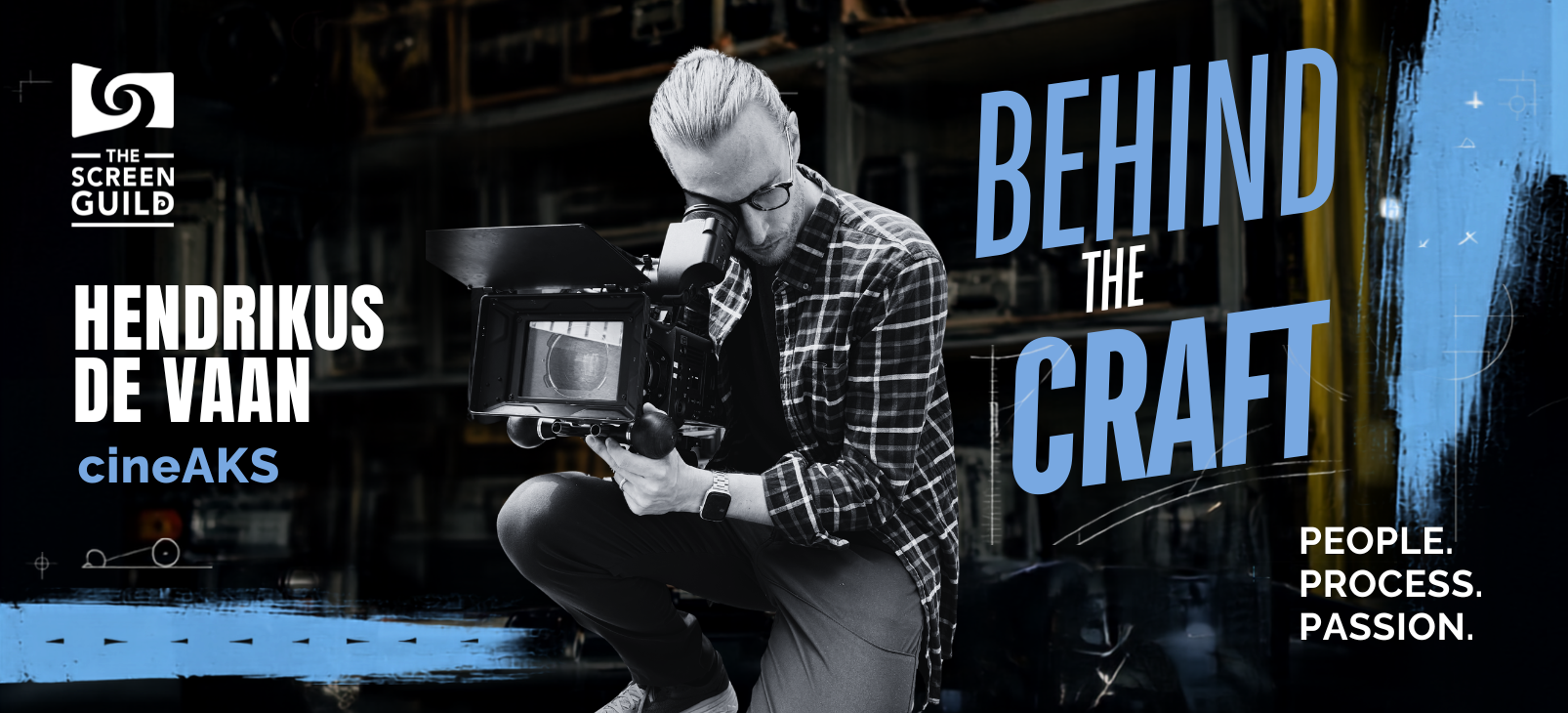
For our first Behind the Craft, we meet cinematographer and cineAKS founder Hendrikus De Vaan, whose habit of questioning how things work, and whether they could work better has taken him from the film set to the workshop and back again.
cineAKS began with you making equipment for yourself before other crew started asking for it too. Can you remember the first moment you thought, “There has to be a better way to do this”?
I don’t think there was one single moment where I decided to start making equipment. It was more of a gradual accumulation of little problems. I’ve always been inclined to make something if I can’t find quite what I want, and working in the screen industry gives you plenty of opportunities to find things that are excellent, but not quite right for the specific use case you need.
A lot of the early cineAKS stuff came from fairly specific frustrations with my own kit. I’d think, “I really want this to work like this,” look around and find that nobody made it that way, and eventually decide it would be easier to make one than keep looking.
That still drives a lot of what I’m working on now. Some of my current R&D exists because I have a fairly niche requirement that apparently isn’t shared by enough people for anyone else to have made the thing yet. I’m 195 cm tall, for example, and getting through doorways with a lot of existing handheld support systems isn’t particularly graceful, so I started designing my own. I then get to use it on set and iterate on it. I’ve also had other crew reach out to make versions of it modified for their use - and I now have a unit out on one of the biggest films in the world, which is very humbling.
I kind of see everything as perpetually broken. That could come across as negative, but I don’t see it that way. To me, it means there is always an opportunity to keep honing things. Nothing is ever really done - we just run out of time.
You’ve worked across several different parts of the screen industry. Which of those experiences has influenced the way you design the most?
Probably working as a cinematographer and spending a lot of time around other departments. Being the person actually using the equipment gives you a pretty good understanding of where the little frustrations are, but working alongside people with very different jobs has been even more valuable. Those additional perspectives really open up areas of development I would never have come to by myself, especially because I came to being a DP through lighting rather than the camera department.
I’ve learned a huge amount from camera assistants, technicians and other crew about how equipment is actually used, abused and adapted on a day-to-day basis - as well as some really niche and specific workflow insights that drive a lot of the R&D I currently have in progress.
I think that has made me fairly interested in the details of how people work. Something can look perfectly sensible on paper but be annoying to use.
More recently, cineAKS has actually introduced me to crew I likely wouldn’t have had much opportunity to work with otherwise. I’ve been able to get feedback from some very experienced ACs and operators while developing new products, and that has been a really useful learning experience.
I’ve also built some really wonderful friendships, and it has been really enjoyable deconstructing the things these amazing crew do so instinctively into their component parts - really understanding, at a deeper mechanical and philosophical level, how they interface with their gear.
I’m learning all the time. I tend to find that almost anything becomes interesting if you get far enough into the details.
We shoot, on average, 20 shots a day. If you allow about 20 minutes per shot, then losing one minute per shot means you’ve lost an entire shot from your day. Efficiency and well-thought-out gear are every bit as important as well-thought-out workflows. Every second counts, so every detail matters.
Once you have an idea, what happens next? How do you know when it’s ready to leave the workshop and go onto a real set?
It varies quite a bit, but usually I’ll start by trying to understand the actual problem rather than immediately deciding what the solution should look like.
I’ll sketch things out, make rough prototypes, and increasingly use CAD and 3D printing to get a feel for dimensions and ergonomics before committing to more expensive materials or machining.
I’m also quite happy to make things for people on a custom basis. If someone comes to me with a very specific problem and I think there’s a reasonable chance that at least a handful of other people might want the same thing, I’ll often absorb the design time myself. The customer gets exactly what they need, and I’ve effectively got an R&D project that may eventually become another cineAKS product.
The point where something is ready for a real set is basically when I’ve stopped finding obvious reasons why it shouldn’t be. Then it goes out and gets used.
The real test is what happens after that. A workshop prototype can be technically successful but still reveal all sorts of little problems once someone has been using it for ten hours on a production. That’s where a lot of the refinement happens.
The final step is production. I try to make as much in-house as possible - so currently everything that is plastic, sewn soft-goods, or wood is made 100% in-house. The metal stuff is machined and anodised externally, but it’s still all hand-assembled by me so I can maintain a level of QC that meets my standards.
You spent time immersed in fine woodworking. What did that experience teach you about materials, craftsmanship and good tools that you still carry into your designs today?
Woodworking probably made me much more conscious of materials and the relationship between a material and the thing you’re asking it to do. It wasn’t the first craft I’d done professionally, as I had a lot of mixed-media experience during my time working in stop-motion animation, as well as hobby experience working with everything from metal to sewing.
I spent a lot of time making things by hand, and you become very aware of how much difference small decisions can make - grain direction, stiffness, weight, edge geometry, how something feels in the hand, how accurately two surfaces meet. But also that every decision matters. I would spend hours laying out my timber, reading the grain, thinking about the “spirit” of the piece, how it would look assembled, and how it might age over the next 100 years. This is exactly why all of my wooden products still have a natural oil and wax finish - because it means you can refinish it in 10,20, 100 years time without needing to sand it, so it maintains its patina and the story of its life.
It also gave me a different appreciation for good tools. I was and am big on hand tools, mostly blacksmith-made Japanese tools, and I make a lot of my own tools also. I think the most interesting thing it taught me is that tools are more than their function. Beautiful, well-thought-out tools that have been built with care and attention to detail can inspire the way you use them.
This translates into my own work. You can use a default profile and just 3D-print something, and it will probably be fine - but I spend a lot of time working on surface finish, maximising geometries for strength, and making things aesthetically pleasing and good to hold. I don’t want stuff to feel like a temporary fix.
I’m generally more interested in making something properly than in finding the absolute cheapest way of making it. I’ll work out what I think the best version of a product should be first, then look at how I can manufacture it at a sensible price with the processes available to me.
Because I’m a very small business with comparatively low overheads, I can sometimes spend more time refining something than a larger manufacturer might be able to justify commercially. If that refinement doesn’t add much cost beyond my own R&D time, it seems entirely worthwhile to me.
Is there one cineAKS product that tells the story of your design process particularly well? We’d love to hear how that idea evolved from the first concept to the finished piece.
The ARRI cForce gears are probably a good example because they started with a very specific requirement and have grown quite a bit from there.
The original idea was essentially to solve a fairly niche offset gearing problem. I made something that worked for the rental house, and then started getting interest from other ACs who had similar problems.
Since then they’ve sold far beyond what I initially expected. They’ve ended up on a lot of the biggest productions around New Zealand, and on productions overseas as well, which has been quite satisfying in itself.
But the more interesting part is what happened afterwards. Once enough ACs were using them, I started getting much more detailed feedback about what they actually needed from a broader system - particularly around mapping and translation between different gearing setups.
So now I’m working on expanding that into a much more comprehensive range, and I’m able to develop it with feedback from people who use this at a very high level every day.
That’s probably a good example of how cineAKS tends to evolve: a very specific problem leads to a very specific solution, which gets used, and then the people using it help reveal the next problem that’s worth solving.
Have there been any ideas that looked promising but simply refused to work? What did they teach you?
There have definitely been a few. It usually falls into one of two problems - it’s either too expensive to manufacture for the problem that it solves, or it’s hard to manufacture consistently at a quality point that I’m happy with. Sometimes it’s just too niche, and I’ll sell a couple of them and then realise that’s market saturation for that particular solution.
I’ve learned not to get too attached to a particular solution just because I’ve already spent time making it.
Sometimes the useful outcome of a failed prototype is simply finding out that one particular approach isn’t worth pursuing. Other times it sends you back to the original problem and makes you realise you were trying to solve the wrong thing.
I think that’s probably one of the benefits of being a small operation. I can afford to follow an idea down a rabbit hole for a while, find out that it’s not worth pursuing further, and then move on to something else.
What’s been the most satisfying moment since starting cineAKS? Was there a point when you realised it had become more than simply making gear for yourself?
I don’t think there was one particular moment where cineAKS suddenly became “a real business”. It’s happening gradually.
Probably the most satisfying moment was seeing a custom camera support rig I designed and built being used on one of the biggest films in the world. That was a pretty surreal experience.
The cForce gears are also a good example. I initially thought they were quite niche, and now they’ve ended up being used on productions all over the world.
But honestly, one of the best parts has been the people I’ve met through doing it.
I’ve ended up talking to and learning from crew who work in quite different parts and tiers of the industry to me. Someone will come to me with a problem I hadn’t even considered, and suddenly I’m learning about a completely different aspect of how equipment is used.
That’s probably what keeps me interested in it. I’m not particularly interested in making products just for the sake of having products. I like figuring out how things work, making something just a little bit better, and then learning from the next person who uses it.
I suspect that’s what cineAKS will continue to be for me - a vehicle for me to keep making things and keep learning.
No items found.
Related articles
No items found.