Beyond the Final Cut: Film Preservation at Ngā Taonga

We spend months, sometimes years, bringing a film to the screen. But how often do we think about what happens to it afterwards? Where will it be in 20, 50 or even 100 years? Will future generations still be able to watch it, and what might it tell them about the people who made it and the world they lived in?
Every film has a life beyond its original release. It captures more than the story being told. There are the places, the people, the language, the fashions and countless small details of everyday life that may seem unremarkable at the time. Decades later, those same images can become a record of a world that has changed or disappeared altogether.
But keeping that record accessible takes more than storing a copy on a shelf. This is where Ngā Taonga Sound & Vision comes in. As Aotearoa New Zealand’s audiovisual archive, Ngā Taonga collects, preserves and provides access to the country’s moving image and sound heritage. Its collections hold not only films and television programmes, but also recordings that document New Zealand’s social, cultural and political history.
And sometimes, preserving a film means having to put it back together.
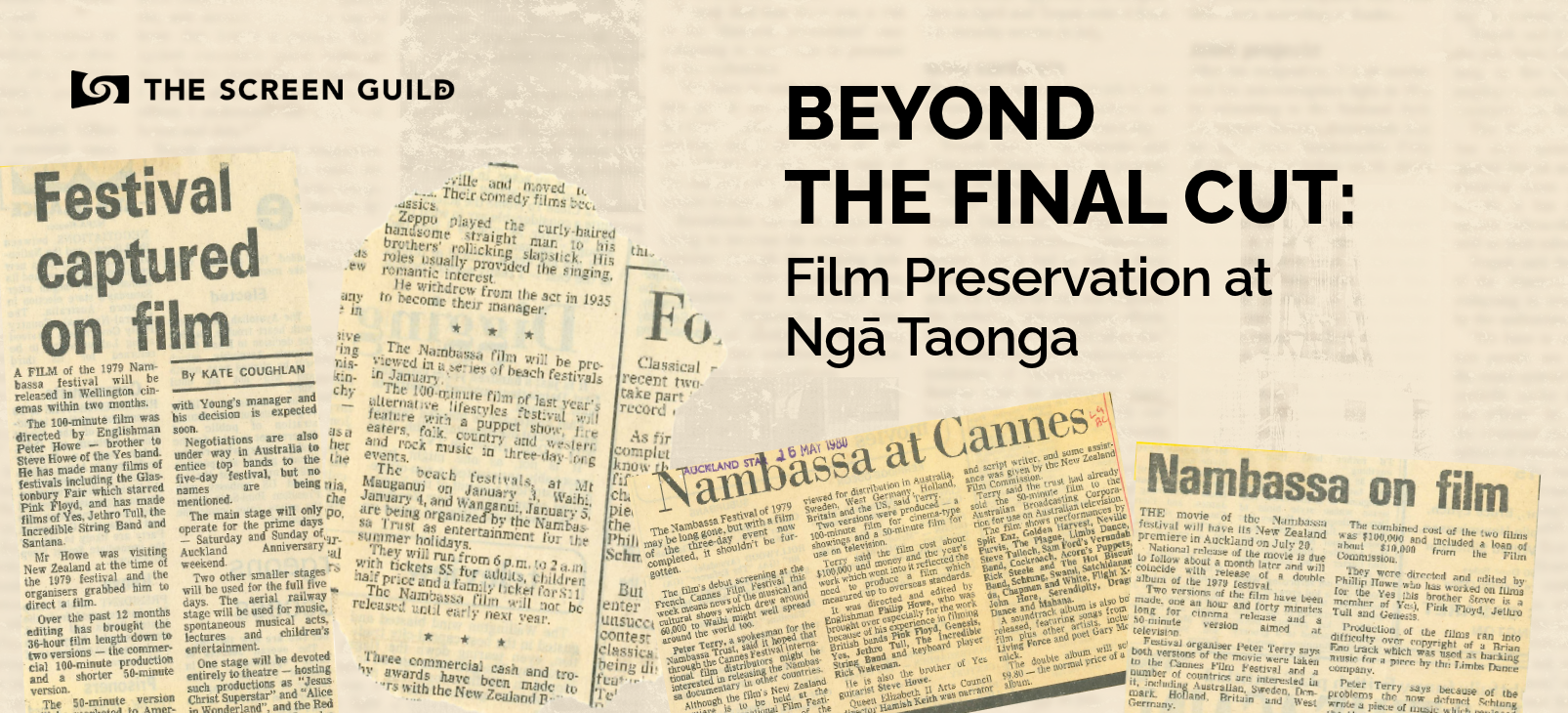
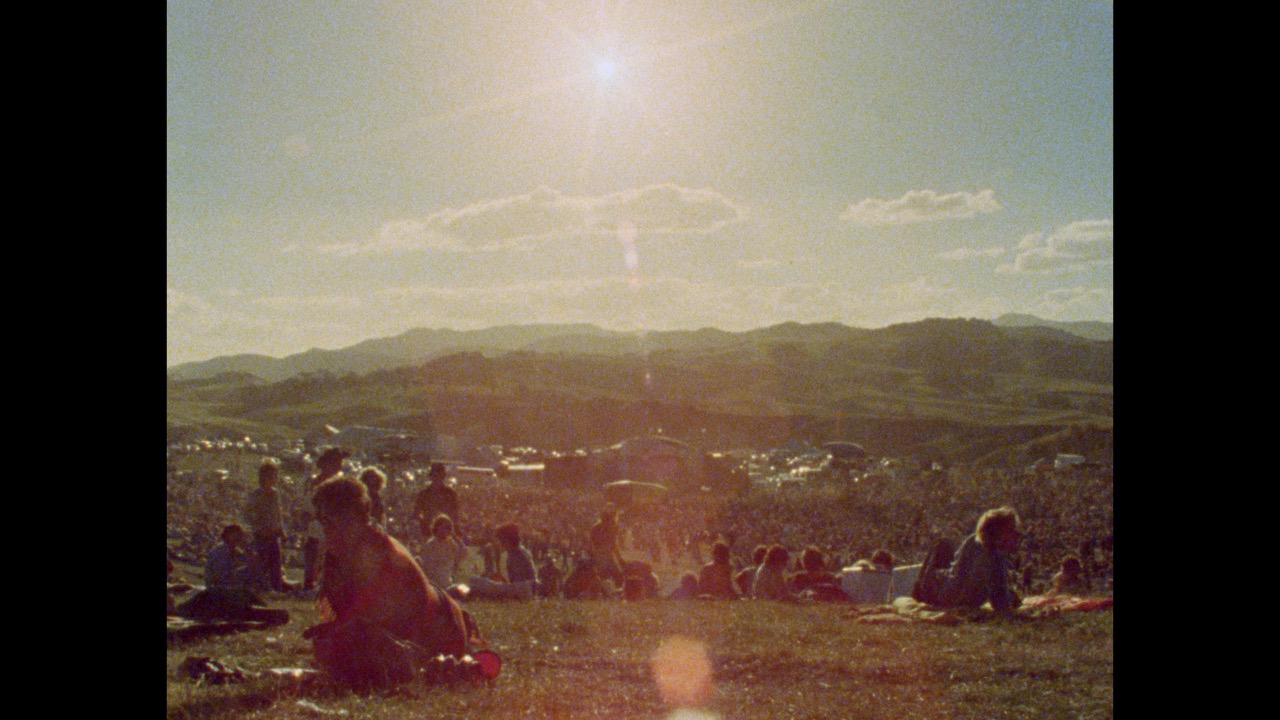
In the summer of 1979, around 60,000 people gathered on a farm near Waihī for the Nambassa Music and Alternative Lifestyles Festival. For three days, the site became a gathering place for music, performances and alternative ways of living, capturing a distinctive moment in New Zealand’s countercultural history.
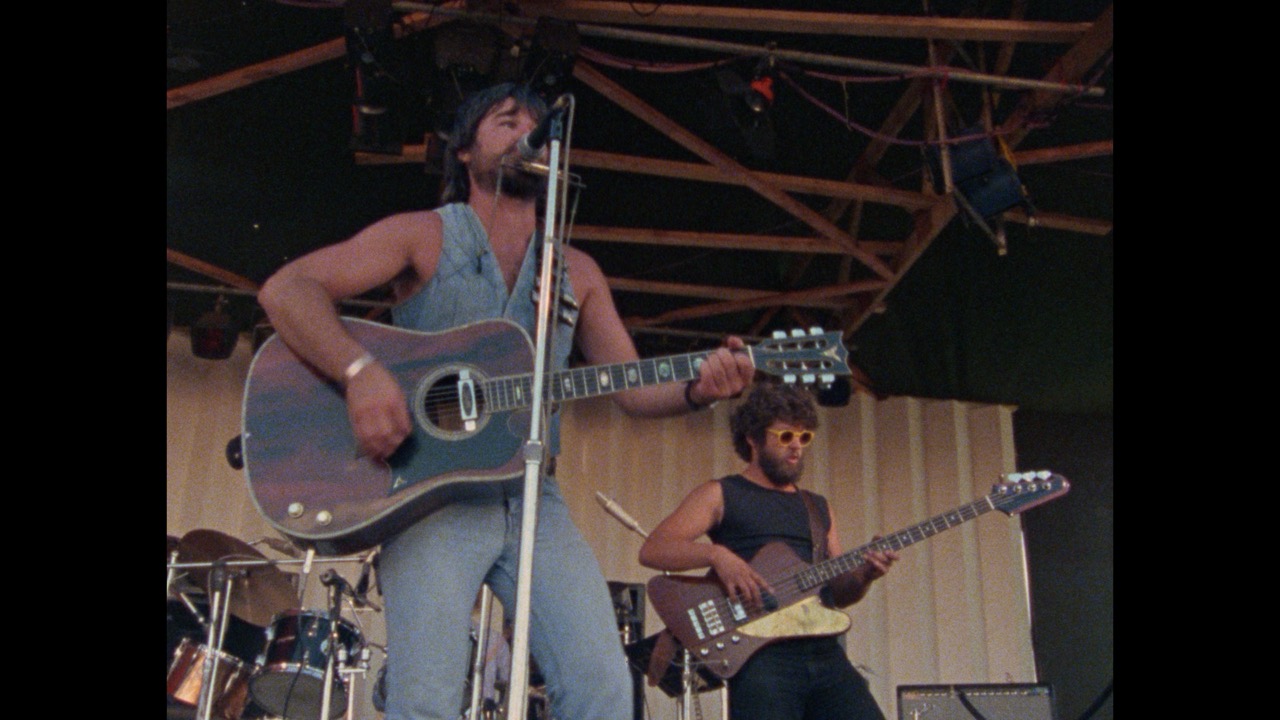
The event was documented on 16mm film by multiple camera crews. English concert film director Phillip Howe assembled 36 hours of footage into Nambassa Festival, a 100-minute documentary capturing the music and alternative culture of the 1979 festival. The film premiered at the Auckland International Film Festival on 20 July 1980.
Forty-six years later, Ngā Taonga set out to bring that same version back to the cinema. There was just one problem: no complete print of the original theatrical cut remained available. The archive’s preservation team worked with surviving pre-print materials to reconstruct the film, recovering the full-length version from an interpositive that had survived intact, while the original negative had been shortened for television.
The result was a newly preserved 4K version of Nambassa Festival, which returned to the New Zealand International Film Festival in 2026.
The project raises some interesting questions about what it takes to preserve our screen history. How do you reconstruct a film when the original theatrical print is no longer available? How do you determine what belongs in the final cut? And how do you balance the possibilities of modern technology with the filmmaker’s original intentions?
These are questions that go well beyond a single film, particularly as the industry continues to move towards digital production and delivery.To find out what went into bringing Nambassa Festival back to the screen, we put our questions to the preservation team at Ngā Taonga Sound & Vision, from the challenges of working with decades-old film materials to the decisions involved in recreating the original cinema experience.
Nambassa Festival had been on Ngā Taonga’s preservation wish list for some time. What led to the project going ahead in 2026, and what did the preservation team find when they first examined the surviving film materials?
With over 80,000 film titles in our collection, there’s quite a queue for film preservation, and as a charitable trust, we do have limited resources. Ngā Taonga considers accessibility, uniqueness and cultural significance when selecting titles for preservation, and Nambassa Festival ticked all of those boxes in spades.
With no complete print of the original theatrical version remaining, how did the preservation team establish what audiences would have seen in 1980? What materials or references helped guide the reconstruction of the 100-minute cut?
We had no print for reference for the feature version (just a heavily compressed 1990s sd telecine of the shortened television cut). So, we scanned the two master materials we held (the master negative and interpositive - the first generation downstream of the master negative) and compared the two, confirming the master negative was cut down for a one-hour TV version. We scanned the negative for preservation purposes, and the IP (interpositive) as our preservation master material, as it was complete, closer generationally to the release version, and the colour and image quality were more than sufficient to retrieve the detail we saw in the camera originals.
The preservation team worked from pre-print materials and other sources to reconstruct missing scenes. Could you talk us through one particular scene or sequence that had to be rebuilt, and how the team worked out where it belonged?
Actually, the interpositive was complete. We compared multiple versions as described above. The scenes absent in the shortened version were mostly some of the musical performances. In terms of the colour grading, the tone and feel of the film was established by the material we already held, and the SD telecine reference was useful to give us a sense of time-of-day and tone. Interpositives, as an intermediate stock, often add a bit of a colour twist compared to camera originals, and in this instance, there was an underlying pink in the whites, which occasionally affected the greens in a slightly artificial way that we had to correct for, which was fairly often in a festival on a kiwi farm!
The original production involved multiple 16mm camera crews, cameras covering the main stage, aerial filming and stereo sound. Nearly 50 years later, what did those original filmmaking choices mean for the preservation process?
On the whole the stocks were pretty uniform, which made the footage match quite well. The film was shot, composed and exposed well, whether capturing the performers or audience, both day and night - no mean feat in the context of a music festival with shifting weather and conditions. Some scenes were more challenging, especially dawn, dusk and night shots. A few scenes felt like daytime stocks were used in lower light scenes, which made pulling out the details in the shadows more challenging. Some colour changes are baked into the interpositive, which can be really helpful, and the telecine reference was useful for determining the time of day.
The audio recordings of the band were taken from a clean line from the mixing desk, so the recordings have fantastic fidelity. One challenge with the audio was that we had two sources for the final audio – sound negative and 35mm magnetic master, with the latter being much cleaner and brighter than the former, but the lower fidelity optical sound negative representing the final signal equalistion intended for the audience.
Ngā Taonga’s preservation approach is to return films as closely as possible to their intended state rather than modernising them. Was there a particularly difficult judgement call on Nambassa Festival around what to restore, what to leave alone, or what was genuinely part of the original film?
Knowing what our target is - to preserve the master materials and present the film as it was originally seen by audiences - makes it easier for us to know when we’re getting towards completion. There’s always the temptation to do more - to repair damage or to enhance colours, but we have a clear moment in time that we’re trying to reach, being the first time it was projected, gives us a clear reference for where to get to. We try to approximate the look of the print, retaining the detail of the master material.
We give consideration to the inevitable differences in how this digital version will be seen, all of which are fundamentally different to the original analog experience. We did do some restoration when it was required, for example one of the scenes had something that looked like a bit of water damage that was quite bad on a few frames that we assessed would be ok to fix.
The sound presented a challenge, with the two sound materials being the 16mm magnetic master and the optical variable area sound negative that was derived from it. The sound negative has relatively poor fidelity by modern standards, and the magnetic master sounded crystal clear, but was purposefully mastered with an overly sharp ‘academy’ EQ curve, which was naturally rolled off in the photochemical process of transferring it to optical sound neg. We had to carefully compare the two and softened the top end of the digitised master mag wav file to match the EQ audiences would’ve heard in the original sound. The result was a much more detailed sound experience that emulates the character of the original film as closely as possible.
Was there anything in the surviving material that surprised the preservation team, something unexpected, or something that changed the team’s understanding of the film?
Having initially scanned and watched down the shortened master negative, it was great to see the full cut for the first time, and a real testament to the image quality of 16mm, and skill of the crews and labs at that time, to see how much detail is retained from the master negative in the interpositive. We also really enjoyed the film. The long-form observational style, without quick cuts or voiceovers, felt very immersive. The shorter version is forced to remove some of the performances, and it’s great to see those restored in the full version.
Who was involved in the preservation of Nambassa Festival, and what different skills or areas of expertise did the project require?
Leslie Lewis produced the project, and Kurt Otzen repaired and prepared the physical film and sound for digitisation. Sara Pattison and Richard Falkner scanned the film, with Richard on-lining and restoring the sound. Damian McDonnell was the colourist, and finished the film, with the DCP authored by Rajeev Mishra in our Digital Delivery Team.
Nambassa Festival returned to the big screen at NZIFF this year following the preservation. What happens to the film now? How will the new 4K preservation be cared for long-term, and will there be opportunities for audiences to see it again in the future?
We’ve archived the preserved materials we created in our digital vaults, copies of which are stored across multiple locations. We will maintain these and the original film materials that the rights holders have deposited with us, ensuring these taonga can be treasured for generations to come.
Preserving the Films We’re Making Today
The story of Nambassa Festival is a reminder that a film’s future isn’t guaranteed simply because it has been completed and released. The work of preserving it can continue for decades, often involving people who had no part in its original production.
And while we tend to associate film preservation with older productions, the decisions that determine whether a film survives are being made today. In its October 2026 newsletter, the New Zealand Film Commission (NZFC) announced that its funding team would begin asking filmmakers about their plans to deposit their films with Ngā Taonga as part of the delivery process for NZFC-funded feature films. The Commission is also developing guidance and a formal process to make this easier.
It’s a welcome step towards making long-term preservation part of the conversation while films are still being produced, rather than something to consider decades later. The films we make today will one day tell future audiences something about the world we live in now. And perhaps that’s worth remembering the next time we wrap a production: our work doesn’t necessarily end when the film reaches the screen.
Film stills and archival newspaper clippings courtesy of Nambassa Trust and Peter Terry / Ngā Taonga Sound & Vision